Integration with Your Tech Stack
Bridging Ontologies and Applications
An ontology's value materialises through integration with applications, databases, and analytical workflows. Isolated ontologies, however elegant, provide no practical benefit. This slide explores how your OOP, database, and programming skills enable effective ontology deployment within technical ecosystems.
APIs and Libraries: Your Gateway to Ontology Manipulation
RDF libraries provide programmatic ontology access. These mature frameworks handle parsing, querying, manipulation, and serialisation—freeing you to focus on application logic rather than low-level RDF mechanics.
Apache Jena (Java): The most comprehensive and mature RDF/OWL framework. Jena provides complete ontology manipulation capabilities—loading OWL files, navigating class hierarchies, querying with SPARQL, invoking reasoners, and serialising to various formats.
Jena's Model interface represents RDF graphs; OntModel extends this with ontology-specific operations. You can programmatically create classes, define properties, establish restrictions, and populate instances—everything achievable through Protégé's GUI becomes scriptable through Jena's API. This enables automated ontology generation, systematic population from databases, and integration within larger application architectures.
RDFLib (Python): The standard Python library for RDF manipulation. Whilst less comprehensive than Jena, RDFLib handles most common requirements—parsing RDF/OWL, executing SPARQL queries, traversing graphs, and serialising to multiple formats. Its Pythonic API integrates naturally with data science workflows, making it ideal when ontologies intersect with machine learning, statistical analysis, or scientific computing.
RDFLib's plugin architecture supports various parsers, serialisers, and stores. Integration with Jupyter notebooks facilitates exploratory ontology analysis and visualisation—useful for validating ontology structure or presenting results to stakeholders.
dotNetRDF (C#): Comprehensive RDF support for .NET environments. If your application stack centres on Microsoft technologies—ASP.NET web applications, Azure cloud services, enterprise integration with SharePoint or Dynamics—dotNetRDF provides native .NET ontology manipulation whilst maintaining compatibility with RDF standards.
Selection criteria: Choose Jena for production systems requiring robustness, comprehensive OWL support, and mature reasoner integration. Choose RDFLib for rapid prototyping, data science integration, or Python-centric environments. Choose dotNetRDF when .NET ecosystem integration outweighs other considerations.
Triple Stores Versus Relational Databases
Storage architecture profoundly affects query performance, reasoning capabilities, and integration patterns. The fundamental question: should your ontology live in a triple store or a traditional relational database?
Triple Stores: Purpose-built for RDF data storage and SPARQL query processing. GraphDB, Virtuoso, Apache Jena TDB, Blazegraph, and others store subject-predicate-object triples natively, optimising for graph traversal queries. They provide native SPARQL endpoints, efficient reasoning support, and seamless integration with semantic web standards.
Reasoner integration: Triple stores often provide integrated reasoning (materialisation or query-time inference), automatically computing transitive closures, property inheritance, and classification. This eliminates custom inference logic in application code.
Relational Databases: Traditional RDBMS (MySQL, PostgreSQL, Oracle) can store RDF through schema mapping—triples become rows in relational tables. This approach suits organisations with existing relational infrastructure, deep SQL expertise, and requirements for tight integration with legacy systems.
However, the impedance mismatch is substantial.: RDF's graph structure maps awkwardly to relational tables. SPARQL queries translate to complex SQL with numerous joins, often performing poorly. Reasoning becomes application-level logic rather than database-supported inference. Semantic richness erodes as RDF's flexibility confronts relational schema rigidity.
Hybrid approaches exist: Store the authoritative ontology in a triple store, but materialise frequently-accessed views into relational databases for performance-critical queries. This balances semantic richness with query performance, though at the cost of synchronisation complexity.
SPARQL Queries: The Query Language for Graphs
SPARQL is to ontologies what SQL is to relational databases—the standard query language. Mastering SPARQL is non-negotiable for effective ontology deployment.
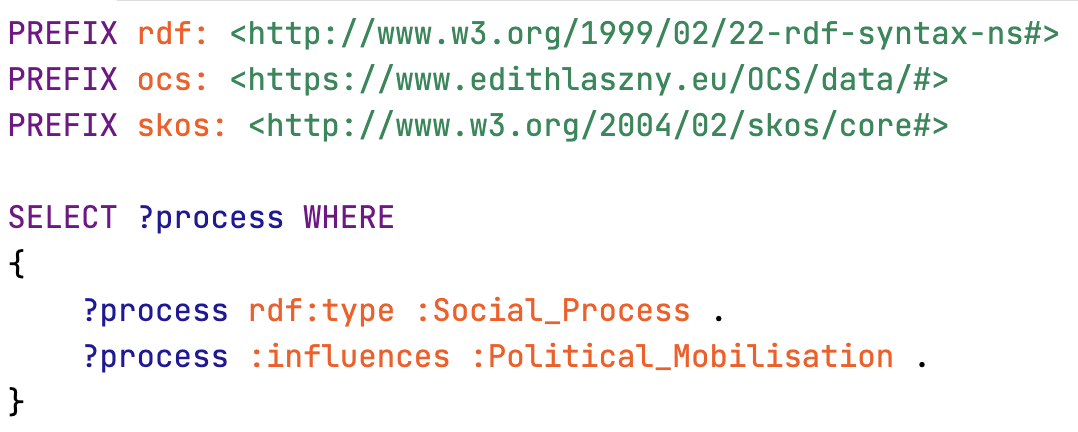
Basic pattern matching: SPARQL queries specify graph patterns—templates of triples with variables. The query engine finds all variable bindings matching the pattern. "Find all social processes that influence political mobilisation" becomes:
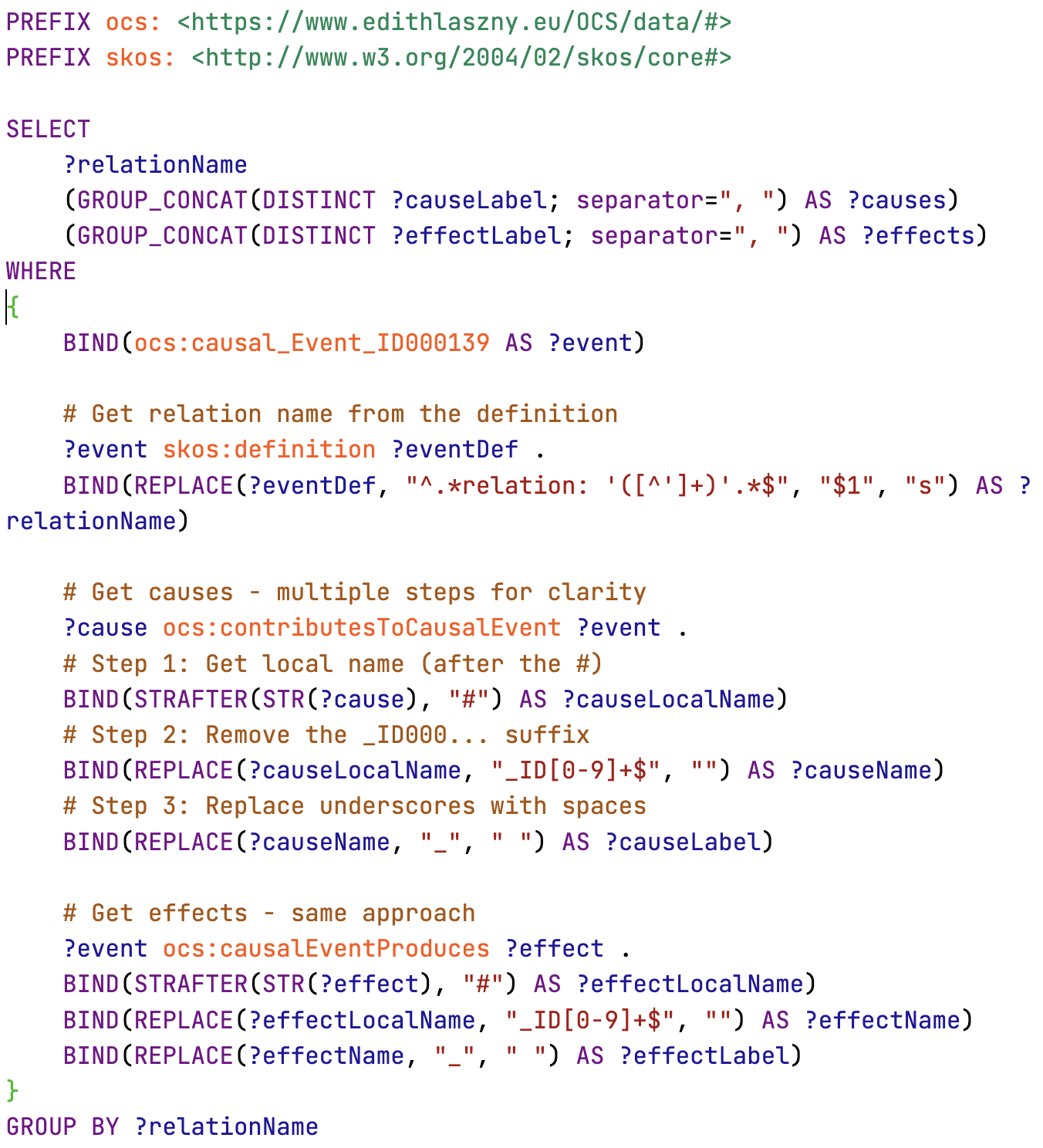
Advanced features matter: SPARQL 1.1 introduced crucial capabilities—aggregation (COUNT, SUM, AVG), property paths for transitive queries, subqueries, and federated queries spanning multiple SPARQL endpoints. The reference ontology's sophisticated causal relationships benefit from property path queries traversing multi-step inference chains,- see the following (quite complicated) SPARQL script:
Integration with application code: RDF libraries provide SPARQL execution APIs. Jena's QueryExecution interface executes queries and returns results as Java objects. RDFLib's query method returns Python bindings. This enables embedding SPARQL queries within application logic, parameterising queries with user input, and processing results through standard programming constructs.
Export and Import Workflows
Ontologies rarely exist in isolation. Import/export workflows enable data exchange, backup/restore, format conversion, and tool interoperability.
Export scenarios: Generate RDF/XML, Turtle, JSON-LD, or other serialisations for external consumers. Export subgraphs for focused analysis. Generate documentation (HTML, PDF) from ontology annotations. The reference ontology's development includes export utilities generating human-readable HTML browsing interfaces alongside machine-readable OWL/XML.
Import scenarios: Ingest data from CSV files, relational databases, APIs, or other ontologies. Map external vocabularies to your ontology's concepts. Merge multiple ontologies whilst resolving namespace conflicts and property alignments.
Protégé bidirectional integration remains crucial: Regardless of programmatic workflows, Protégé serves as the visual development environment. Ensure your technical stack can export formats Protégé imports (OWL/XML, RDF/XML, Turtle) and import Protégé's outputs. This enables seamless switching between programmatic generation and visual refinement.
Practical Integration Architecture
A typical deployment architecture for ontology-driven applications:
- Authoritative ontology storage: Triple store (GraphDB)
- SPARQL endpoint: RESTful API exposing ontology queries to applications
- Application layer: Java/Python services executing business logic, formulating SPARQL queries, processing results
- Caching layer: Optional relational database or key-value store caching frequent query results
- User interface: Web application or desktop tool presenting ontology-derived insights
This architecture separates concerns—ontology management, query processing, business logic, and presentation—enabling independent evolution of each layer whilst maintaining integration through standard interfaces (SPARQL, REST APIs).